
The last time I took Wilderness First Aid (WFA) was in January 2020. A few months later, the world shut down. When it came time to recertify in 2022, life wasn’t back to normal, or even the new normal, and spending a weekend taking a WFA class didn’t make my top ten. It should have.
I enjoyed nearly 70 trail days in 2023 without a serious mishap to myself or others with me; however, earlier this year, while on an urban hike, I saw a young girl playing with her sisters fall and cut herself. The mother didn’t have anything to clean or bandage the wound, so I stopped and rinsed off the area with clean water, stopped the bleeding, and gave mom a band-aid before moving on. For the rest of the day, I kept remembering bits and pieces of previous training and things I could have done better.
Retaking WFA cracked the top five.
This Memorial Day Weekend, instead of venturing outdoors, I joined thirty other students from a variety of different ages and backgrounds in a NOLS REI-partnered two-day Wilderness First Aid class led by two fantastic NOLS Wilderness Medicine Instructors: Molly and Emily.
——————————
Most of the time, we reside in an urban environment; a call to 9-1-1 or a quick trip to the hospital is all we need to do. However, there could also be a natural disaster or civil unrest, and 9-1-1 might not be available. And you don’t have to be far from your car, where using a cell phone to call for help is no longer an option, and an ambulance isn’t making it up that singletrack.
What do you think you would do in a backcountry medical emergency? How would you care for a sick or injured friend or family member? Would you stop and count to five? Do you know your A-B-C-D-Es? How do you perform a thorough Head-to-Toe examination, log vitals, and take a patient S-A-M-P-L-E? (Hint: you need gloves.) And that’s only the beginning.
It reminds me of what W. Edwards Deming said, “Learning is not compulsory… neither is survival.”
I don’t write this to scare anyone but rather to remind would-be adventurers that they need to be prepared. If you spend enough time outdoors, something serious will happen—if not to you, then to someone you are with or someone you come across.
——————————
As mentioned above, this was not my first WFA course (there have also been a couple of Wilderness Advanced First Aid classes over the years), but it was easily among the best. NOLS instructors Molly and Emily were outstanding. They tag-teamed between topics and created a welcoming environment that made people comfortable and eager to participate. They covered the required materials in detail and provided real-life examples of mistakes they made in the field. They answered our questions, though most of the “this happened to me” or “what if” questions that weren’t tied to the current topic or relevant to the majority of the class were handled one-on-one during the breaks. This was good since it kept the class focused and made the best use of the time available.
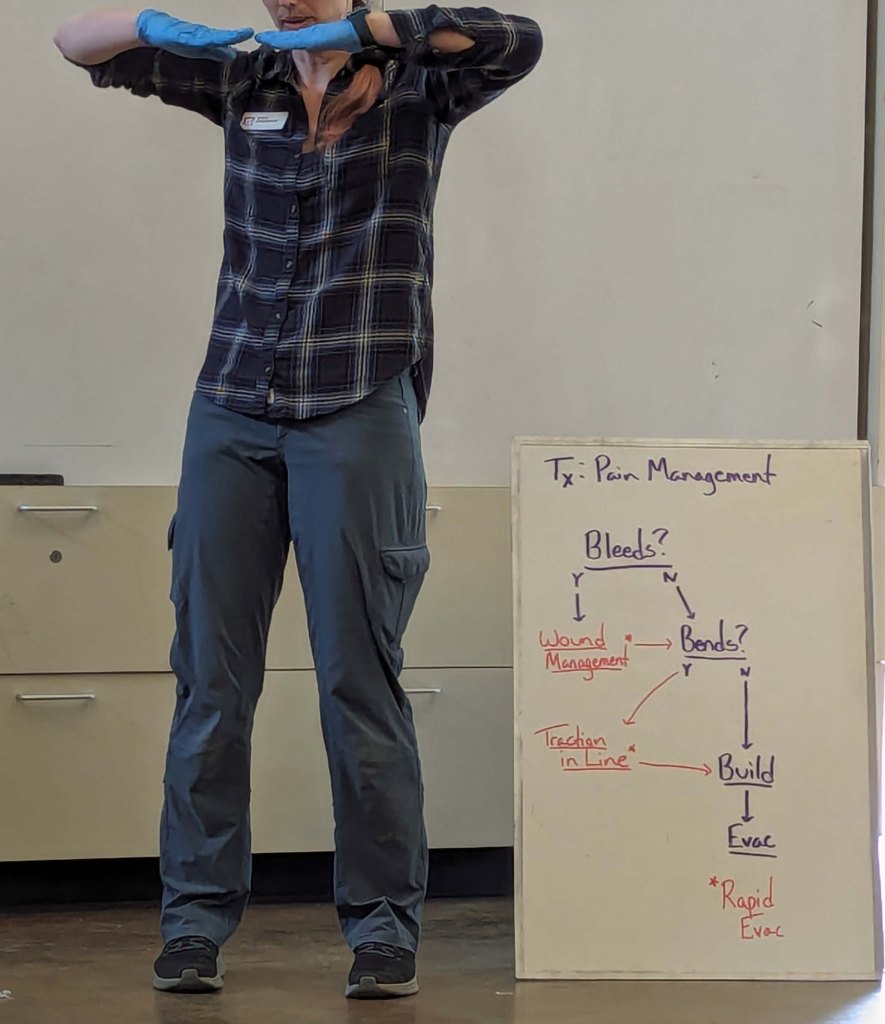
The instructors switched between lectures, demonstrations, and scenarios, with almost half our time outside. Everyone had the opportunity to be a responder and a victim. (Counterintuitively, you often learn as much being the ‘victim’ as you do being a responder.) We were strongly encouraged to work with different people, so we didn’t start depending on or deferring to someone. I was impressed with the clearly understandable instructions and feedback and amazed at how Emily and Molly moved from group to group: they always seemed to be where needed.

——————————
Just because you have taken WFA in the past doesn’t mean you don’t need a refresher. Every time I take a WFA course, I’m humbled about how much I didn’t know and how much I forgot. There’s also the fact that WFA protocols have changed over time. What was once standard procedure twenty years ago is no longer taught. It’s another good reason to stay current.
Question for the reader: What’s in your first aid kit, why is it there, do you know how to use it properly, and is there anything that needs to be added?
——————————
A benefit of the two-day course was the chance to meet new people and listen to their stories. Ours was a diverse group of learners: young and old, men and women, and a wide variety of backgrounds. We all had one thing in common: we wanted to be better prepared in case of an accident or illness. Add to that Molly and Emily: two educated and accomplished adventurers.
——————————
If you subscribe to Adventure Journal (if not, you should), you know about the mini-bios under the title Historical Badass. (Badass, in this context, is a very complimentary term.) Molly is an honest-to-goodness, warm-hearted badass. She has and continues to lead, an adventurous life. If I were putting together a team to do something hard, I would want her on it, especially if things start to go wrong.
It is so easy to get hyper-focused on what and how to do wilderness first aid protocols and procedures – it is, after all, a stressful situation – that you forget to consider the patient is also having a bad day. I’ve never had another instructor who could connect with me about considering human needs and patient dignity as Emily did. She is a wonderfully caring person.
——————————
If you recreate outside, and your adventures take you beyond where help can quickly and easily get to you, I strongly encourage you to take a Wilderness First Aid Class. The cost of the class is nominal (nobody is getting rich here), especially considering the skills you will gain. It is time well spent, and it could save a life.
For more information, go to https://www.rei.com/events/46423/wilderness-first-aid-2-day-class or https://www.nols.edu/en/wilderness-medicine/courses/.
 Adventure-to-Adventure